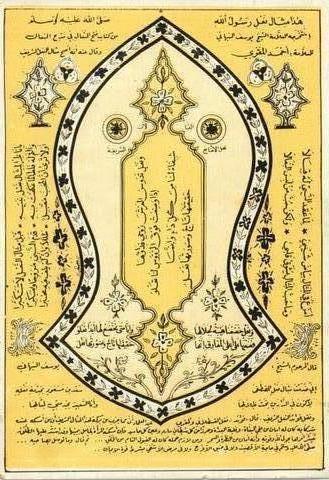
The Nalain Shareef - Increasing Love of Prophet(s) and getting Madaat-support/assistance through the Tabarrak-holy relic “The Sandal” of the Prophet Muhammad (sallalahu alaihi wa sallam) In Arabic the Prophet’s sandal is known as ‘Nal al-Nabiiy’. Also its mentioned that one of the names of the Prophet in the ancient books is sahib al-na`layn or “The wearer of the two sandals.”


The Nalain Shareef are the Sandals of the Prophet Muhammad (Salla Allahu ta’ala ‘alayhi wa Sallam), which were used by the Prophet (Salla Allahu ta’ala ‘alayhi wa Sallam) in His life. Below are some of the ‘barakah’ blessings one can acquire by keeping and honouring themselves with a copy of the sacred Nalain shareef. Not the actual or original Blessed shoe/slipper of our Noble
Prophet (Salla Allahu ta’ala ‘alayhi wa Sallam) but a cut out man made paper copy. Because the intention is to make and shape it to be in the manner of our Prophets it holds such value and is revered as it has nisbah with the ‘Nalain Paak’ worn on the Noble feet of the Greatest of Mankind.
An original pair of the Prophets (Salla Allahu ta’ala ‘alayhi wa Sallam) ‘Nalain As Shareef’ have been kept and safeguarded in the Famous Islamic Museum the Blue Mosque in Turkey
The Image or photocopy which you see in the post is a copy/print are impression together with the description of the Blessings obtained by the Nalain Shareef.
They are a lot of Blessings to be obtained by the Nalain shareef and to be kept in a purse for barkat or framed in a wall is very popular.
Abu Ishaq said: al-Qasim ibn Muhammad, son of Abu Bakr al-Siddiq R.A, said: Of the proven blessing of the likeness of the Prophet’s sallallahu alaihe wasallam (S.A.W) sandal is that whoever has it in his possession for tabarruk, it will safeguard him from the sedition of rebels and the mastery of enemies, and will be a barrier against every recreant devil and the evil eye of the envious. If the pregnant woman holds it in her right hand at the time of labour, her delivery will be easier by Allah’s change and His might.
Al-Qastallani relates the account of a pious shaykh by the name of Abu Ja`far Ahmad ibn `Abd al-Majid:
I cut the pattern of this sandal for one of my students. He came to me one day and said: “I saw a wonder yesterday from the blessing of this sandal. My wife was suffered from a pain which almost took her life. I placed the sandal on the spot of her pain and said: O Allah subhana watallah (S.W.T), show me the blessing of the owner of this sandal. Allah cured her on the spot.”
al-Munawi and al-Qari mentioned in their commentary on Tirmidhi’s al-Shama’il that Ibn al-`Arabi said that the sandals are part of the attire of prophets, and the people only left them due to the mud in their lands. He also mentioned that one of the names of the Prophet in the ancient books is sahib al-na`layn or “The wearer of the two sandals.”
Certain great Sahaba’s have distinguished themselves with serving the noble sandals. It has been reported by Ibn Sa`d that Anas (Allah be well pleased with him) was the keeper of the sandals of the Messenger of Allah (Allah bless him and give him peace).
And Imam al-Salihi reported that `Abd Allah ibn Mas`ud (Allah be pleased with him) used to get up as soon as the Messenger of Allah (Allah bless him and give him peace) sat down, and would take off the His sandals, and place them under his own arms. Then, when the Prophet (Allah bless him and give him peace) would get up, he would put them on him. He was often called ‘the Caretaker of the sandals, couch and water bag’.
Hadrat Fatima Zahra (Radi Allahu anha) who went to the resting place of her Beloved father (Salla Allahu ta’ala ‘alayhi wa Sallam) and taking a handful of dust put it to her eyes saying;
“One who smells the dust of the grave of the Most Beloved Messenger (Salla Allahu ta’ala ‘alayhi wa Sallam) of Allah would not need to smell any other perfume in His life, Such calamities have befallen me that if they had descended upon days they would have fallen into nights.”
The Ulema and the A’imma have requested that the Nalain Shareef (sandals) of the Holy Prophet (Sall’Allahu Ta’ala Alayhi Wa’alihi Wa’sallam) to be printed on paper and in books. An actual picture of the Holy Prophet’s (Sall’Allahu Ta’ala Alayhi Wa’alihi Wa’sallam) Nalain Shareef or an impression together with a description of the blessings is utilised to obtain blessings of Nalain Shareef. There are many blessingsfor a person to keep a picture of Nalian Shareef with him. This is not uncommon to see Muslims of all ages wearing badges in the shape of Nalain Shareef. The Ulema have commanded that it be kissed, rubbed over the yes or kept on the head.آ It can be used as mediation, cure for illness and has great blessings.
When Musa (Alayhi sallam) went to Mount Toor to speak to Allah Ta’ala he was asked to remove His sandals.آ However, during Mira’j when the Holy Prophet (Sall’Allahu Ta’ala Alayhi Wa’alihi Wa’sallam) went to see Allah Ta’alla He wore His Nalain Shareef but He was not ordered to remove them.Some people say that pictures of the Nalain Shareef of the Holy Prophet (Sall’Allahu Ta’ala Alayhi Wa’alihi Wa’sallam) are doubtful, that these pictures are made of the local ink and paper and, therefore, to kiss this picture is not permissible.
The picture of the Nalain Mubarak is the photocopy of the holy sandals, which were used by the Holy Prophet (Sall’Allahu Ta’ala Alayhi Wa’alihi Wa’sallam) in His life. It bears the description and the related story connected with it. We pay respect to the Holy Qura’an which is printed on the paper with ink or colour used in its printing. Both the paper and the ink are locally manufactured and these were not brought from the Heaven.
But we give due reverence to it believing it as the print of the Holy Qura’an and no other book.آ The respect paid to the printed Qura’an is in fact the respect paid to the Holy Qura’an, which was revealed to the Holy Prophet (Sall’Allahu Ta’ala Alayhi Wa’alihi Wa’sallam)It is mentioned in ‘Al-Kalam-ul-Auazeh’ that a venerable saint, Sheikh Ibn-e-Habib Elahiآ (Rahmathulahi alay) said:
“I placed the sacred impression of the Sandal of the Holy Prophet (Sall’Allahu Ta’ala Alayhi Wa’alihi Wa’sallam) over the abscess that did not get healed by any medicine. I got relief at once.”
The Image or photocopy which you see in the post is a copy/print are impression together with the description of the Blessings obtained by the Nalian Shareef. They are alot of Blessings to be obtained by the Nalian shareef and to be kept in a purse for barkat or framed in a wall is very popular.
Hadrat Fatima Zahra (Radi Allahu anha) who went to the resting place of her Beloved father (Salla Allahu ta’ala ‘alayhi wa Sallam) and taking a handful of dust put it to her eyes saying; “One who smells the dust of the grave of theMost Beloved Messenger (Salla Allahu ta’ala ‘alayhi wa Sallam) of Allah would not need to smell any other perfume in His life, Such calamities have befallen me that if they had descended upon days they would have fallen into nights.”
It is mentioned in Sahih Bukhari; That Hadrat Ali (karam Allahu wajhu) was cured of His eye ailment when the Messenger (Salla Allahu ta’ala ‘alayhi wa Sallam) of Almighty Allah applied his saliva to His eye.
It is also narrated that Hadrat Bilal (Radi Allahu anhu) used to rub his face on the grave of the Beloved Prophet (Salla Allahu ta’ala ‘alayhi wa Sallam).
The practice of Tabarruk was common among the companions of the Beloved Prophet (Salla Allahu ta’ala ‘alayhi wa Sallam) the Noble companions gave the utmost respect to the relics of the Beloved Prophet (Salla Allahu ta’ala ‘alayhi wa Sallam) the companions May Allah raise their ranks, they used to seek blessings from the traces of the Beloved Prophet (Salla Allahu ta’ala ‘alayhi wa Sallam) during his lifetime and death.
They made the relics a means for cure in this world and acquisition of Divine Mercy after death. They obtained Tabarruk from His beloved Body, (Salla Allahu ta’ala ‘alayhi wa Sallam) which gave instant results.
Below are some of the ‘barakah’ blessings one can acquire by keeping and honouring themselves with a copy of the sacred Nalain shareef. Not the actual or original Blessed shoe/slipper of our Noble Prophet (Salla Allahu ta’ala ‘alayhi wa Sallam) but a cut out man made paper copy. Because the intention is to make and shape it to be in the manner of our Prophets it holds such value and is revered as it has nisbah with the ‘Nalain Paak’ worn on the Noble feet of the Greatest of Mankind.
THE BLESSINGS & BENEFITS OF NALAIN SHARIFF
The Great Muslim theologians have listed many benefits and blessings in keeping and venerating a copy of the Nalain Shareef. Some of these are listed below.
* The person will be safe from the harms of the cruel, wickedness of the Satan and from the bad sight of the enviers.
* The pain of childbirth will be eased for eased for the woman who keeps it with her at the time of delivery.
* The person who always keeps a copy of it with him will have respect in the sight of creation.
* He will have the opportunity to see the Blessed Green Dome – Ghumbad-e-Khizra in Madeena Shareef.
* He will have the honour in seeing the Holy Prophet in his dream.
* His property or wealth will be safe in a place where the Nalain Shareef is kept.
* A person’s needs will be met when he prays through the waseela of the Nalain Shareef.
* A person who keeps the Nalain Shareef for a particular reason will have his wishes fulfilled.
* The person will be safe from thieves, calamities and dangers such as drowning.
* The disease and ailments go away when the Nalain Shareef is placed over the affected part.
* Success and deliverance were gained through the Nalain Shareef in oppressive times.
(The Blessings are not limited to the list above but are also obtained when in other circumstances as well.)
Writers and poets wrote eloquently in praise of the noble sandals and in describing the feelings of ecstatic love for their wearer (Allah bless him and give him peace). Imam Abu al-`Abbas gathered a significant amount of these writing in his aforementioned work, as well as in his treatise Azhar al-Riyad
Imam Yusuf al-Nabahani recited about the Prophet’s sallallahu alaihe wasallam (S.A.W) sandals:
May the best of blessings and peace be upon the owner of these blessed sandals.
Verily I serve the image of the Sandal of Mustafa
So that I may live in both worlds under its protection
and
wa na`lun khada`na haybatan li waqariha
fa inna mata nakhda`u li haybatiha na`lu
fa da`ha `ala a`la al-mafariqi innaha
haqiqataha tajun wa surataha na`lu
We are lowered by awe to honour this Sandal.
And whenever we lower before it we are raised.
So place it on the highest shelf!
For indeed in reality it is a crown, though its image is a sandal.
And when Imam al-Fakhani first saw the Prophet’s sallallahu alaihe wasallam (S.A.W) sandals he recited:
wa law qila li al-majnuni layla wa wasluha
turidu am al-dunya wa ma fi zawayaha
laqala ghubarun min turabi ni`aliha
ahabbu ila nafsi wa ashfa li balawaha
And if Layla’s Madman were asked: do you prefer
Union with Layla, or the world and its treasures?
He would answer: “Dust from the earth of her sandals
Is dearer to my soul, and its most soothing remedy.”
The great Ashiq-e-Rasool, Ala Hadrat Rehmatullahi ‘Alaih wrote:
Jo sar pe rakh ne ko
mill ja yai Nalain Paak Hazoor sallallahu alaihe wasallam (S.A.W)
to phir kahain gai ke
haan Tajdaar hum bi hain
If only i get such an honour to place
on my head the Holy Sandals of The Prophet sallallahu alaihe wasallam (S.A.W)
then i would proudly claim that
yes i have been crowned as King as well.
The famous Hindu poet, Dillo Ram wrote (who on his death bed, was visited by the Beloved Prophet sallallahu alaihe wasallam (S.A.W), and accepted Islam):
Gar shams aur qamar ko koi daman mein chupale
aflak ke taro ko koye haatho se chunale
ghar daulat e dahrain ko koye hatho pe uthale
phir koye mujhse pooche ke tu kya leh?
khalqa prasad se pooch ke tu kya lee chand, suraj, sitare, daulat?
phir mein bolo keh nalain e muhammad sallallahu alaihe wasallam (S.A.W) ko ankhon se lagaloo!!
if somebody hides the sun and moon in his lap
if someone with their hands picks the stars collects them,
if somebody lifts the entire treasure’s of the world and puts it on his hands,
and then if somebody asks me what do you want?
do you want sun, moon, stars, the entire treasuere of the world?
then i shall say that i want to put the Sandals of Muhammad sallallahu alaihe wasallam (S.A.W) on my eyes!!